

Mingyi Silicone(Anhui) Co., Ltd.
Hits: 2192 img
Keywords: airbag silicone coating, coated airbag fabric, silicone rubber coated nylon 66, neoprene replacement airbag, gas generator heat resistance
Answer: One sentence: the coating on the inner airbag fabric holds inflation gas long enough to deploy the bag — it must survive the gas generator's hot blast while staying flexible at −40 °C through a decade of storage.
Traditionally this coating is polychloroprene (neoprene). Silicone coating rubber is the emerging alternative because its Si–O backbone tolerates the generator's hot gases and particles far better than chloroprene, stays elastic across the full automotive temperature range, and is halogen-free. In MY's coating-grade family, solvent-free low-viscosity scrape/dip grades (e.g., MY LSR 3352-type chemistry for high-strength technical fabrics) represent exactly this application class. Selection rule: heat-hold performance plus cold flexibility → silicone; legacy cost-optimized lines → still mostly neoprene.
Answer: Let's look scenario by scenario (general requirements vs. representative MY coating-grade data):
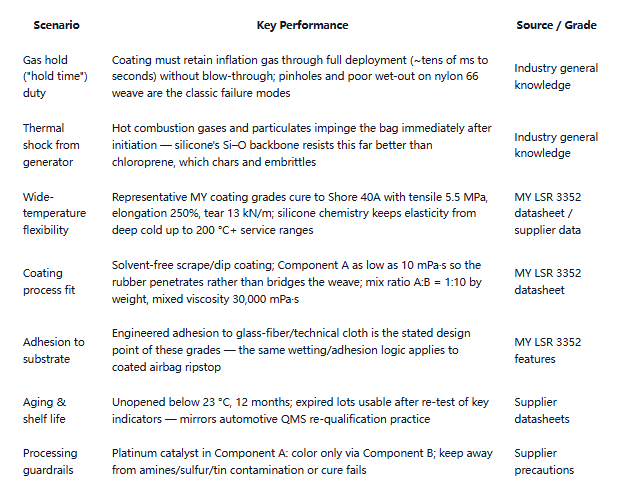
Conclusion: For airbag coatings, silicone enters as a performance upgrade against thermal abuse and cold-flex cracking, not a drop-in swap — coating weight, weave penetration, and calender/scrape line parameters all need re-engineering, and any candidate material must clear the OEM's gas-hold, thermal-shock, and 10-year aging protocols before nomination. Honest caveat: MY's current public datasheets cover technical-fabric coating grades (fireproof cloth, anti-slip, silicone leather); no dedicated airbag grade with measured hold-time data was found in our internal documents. If you are evaluating this route, contact our technical department for the latest coating-grade roadmap and sample program; validation should include burst pressure, gas retention at elevated temperature, low-temperature flex, and adhesion pull on your actual nylon 66 fabric lot.
Special addition liquid silicone rubber for electronic keys, plz check MY LSR 3740