

Mingyi Silicone(Anhui) Co., Ltd.
Hits: 2193 img
Keywords: compression molded silicone rubber, extruded silicone rubber, HTV silicone compound, peroxide-cured silicone, William plasticity, post-curing
Answer: One sentence: an extrusion grade is engineered to flow through a die and hold its profile instantly; a molding grade is built to fill a closed cavity under press pressure without scorching.
Same base chemistry (methyl vinyl polysiloxane + silica + peroxide), different rheology: extrusion compounds like MY HTV 316 series are tuned for fast screw speed and green strength — William plasticity climbs across the range (150→310) as hardness rises — while compression grades like MY HTV 340 series balance plasticity (150–290) against mold-fill and flash control. Selection rule: continuous profiles (tubing, wire, strips) → extrusion grade; discrete 3D parts (seals, caps, keypads) → molding grade.
Answer: Let's look scenario by scenario (based on measured parameters of commercially available grades):
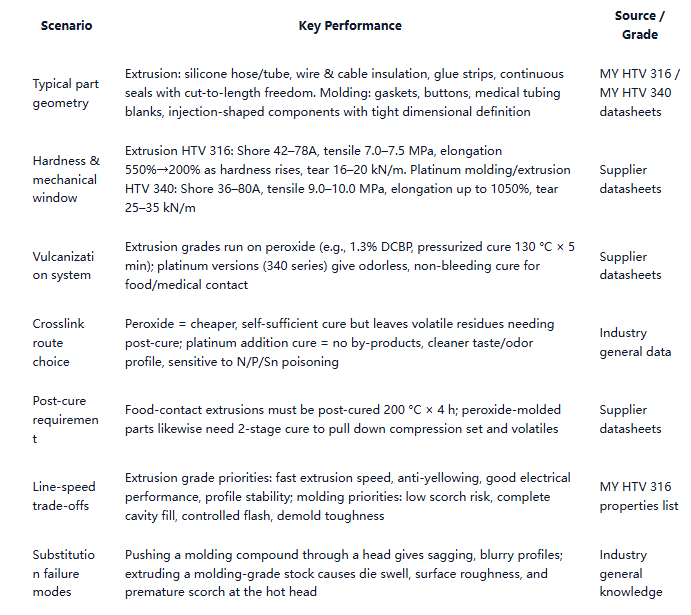
Conclusion: They are line-specific formulations, not interchangeable stocks. The visible dial separating them is rheology — William plasticity and filler treatment are adjusted so extrusion grades shear-thin in the screw yet freeze on exiting the die, while molding grades stay dead-flat on the shelf then flow only under press force. Practical guidance: ① match plasticity to your screw/die geometry before touching hardness — a single grade can span Shore 42–78 with constant line behavior only if plasticity steps are respected; ② decide peroxide vs. platinum at the regulatory stage, not after tooling: food/medical or low-odor cabin parts should start on platinum systems like HTV 340; ③ budget the 200 °C × 4 h post-cure into capacity planning whenever the part contacts food or demands low compression set. Validate final cure state, compression set, and profile tolerance on your own tooling before production release.
Phenyl Liquid Silicone Rubber, plz check MY BLSR 3218